
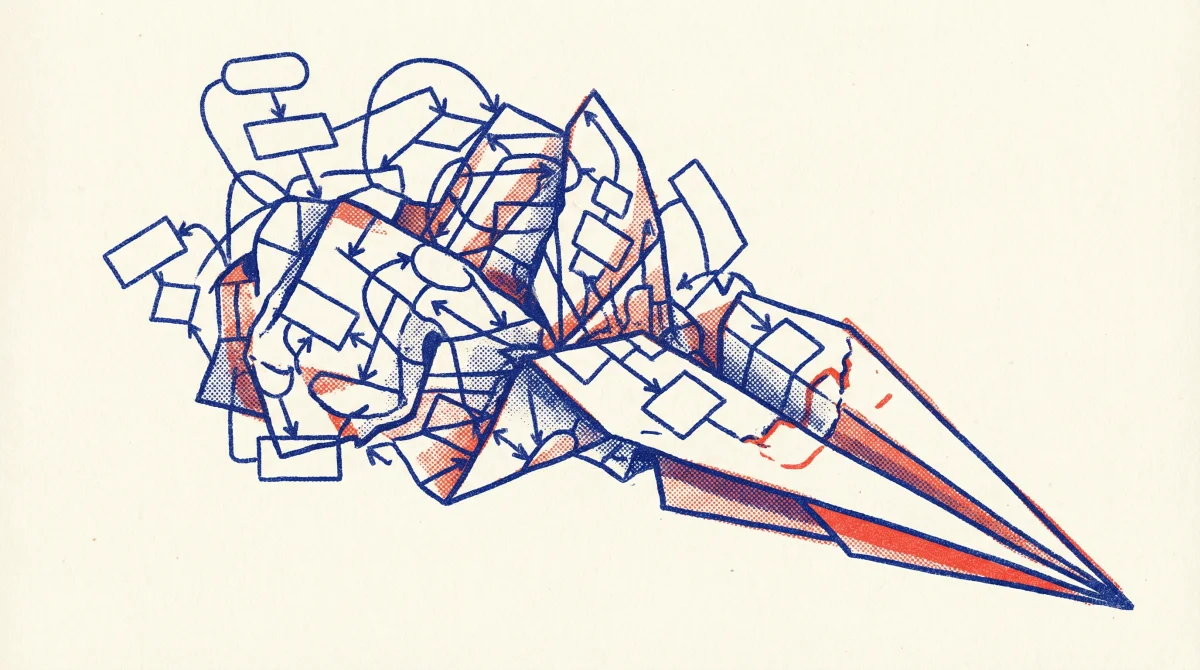
You don’t build automations anymore. You describe what you want done, and the agent figures out how to do it. OpenClaw (formerly Moltbot/Clawdbot) just made “vibe automation” real.
Two years ago, Andrej Karpathy coined “vibe coding”: describing what you want instead of writing every line. Now the same shift is hitting automation. Call it vibe automation: you tell an AI agent what needs to happen, and it handles the how.
The Workflow Problem
I spent three hours last week building a workflow to remind me about stale deals. Create trigger. Add filter node. Configure date comparison. Add notification step. Test. Debug. Redeploy.
The workflow runs once a day. It took longer to build than it saves.
| Task | Traditional Workflow | OpenClaw |
|---|---|---|
| Stale deal alerts | 3 hours | “Remind me about deals with no activity for 7 days” |
| Morning briefing | 2 hours | “Every morning at 8am, summarize my calendar and flagged emails” |
| CRM hygiene | 4 hours | “Watch for contacts missing phone numbers, prompt me to fix them” |
That’s the gap. Workflow tools excel at repeatable, high-volume processes: lead routing, data sync, webhook handling. But most of our days are filled with smaller tasks that aren’t worth the build time.
What Vibe Automation Actually Means
Traditional automation is declarative. You specify triggers, conditions, and actions. You build the machine.
Vibe automation is intent-based. You describe the outcome. The agent builds (and rebuilds) the process.
flowchart LR
    A([Old: Build workflow]) --> B([Deploy]) --> C([Hope it works])
    D([New: Describe intent]) --> E([Agent executes]) --> F([Iterate in conversation])
    classDef default fill:#dbeafe,stroke:#3b82f6,color:#1e40af,stroke-width:2px
OpenClaw doesn’t just run tasks. It watches patterns, suggests automations, and adapts when things change.
Last Tuesday, I noticed OpenClaw prompting me: “You’ve checked the Apollo dashboard at 9am the last four days. Want me to send you a summary instead?” I said yes. Now it runs as a cron.
That’s not workflow building. That’s the workflow building itself.
The Claude Code Parallel
If you’ve used Claude Code, you know the pattern. You don’t write every line. You describe what you want, review what it builds, iterate. The AI handles the mechanical work.
OpenClaw is Claude Code for everything else.
| Claude Code | OpenClaw |
|---|---|
| “Add error handling to this function” | “Alert me when any API in my stack returns 5xx” |
| “Refactor this to use TypeScript” | “Convert my morning checklist into scheduled tasks” |
| “Write tests for this module” | “Watch my calendar and warn me if I’m double-booked” |
Both tools let you operate at the intent layer. The implementation is the AI’s problem.
What OpenClaw Does Differently
Process creation from conversation. Describe a recurring task once. OpenClaw creates the cron, handles the scheduling, and runs it. No canvas. No nodes. No wires.
Activity monitoring. It watches what you do: emails you send, apps you open, patterns you repeat. And suggests automations. “You always check Slack after every Zoom call. Should I summarize new messages automatically?”
Staying on task. Set a goal. OpenClaw checks in. “You said you’d finish the proposal by 3pm. It’s 2:30 and you’ve been on Twitter for 20 minutes.” Accountability that doesn’t require an app.
Adaptive scheduling. Crons that learn. If your “daily standup summary” keeps getting snoozed on Fridays, OpenClaw notices and asks if you want to skip Fridays.
Workflows vs Agents: Different Jobs
Workflow tools aren’t going anywhere. For production automation (lead routing at scale, data pipelines, webhook handling) you want explicit, testable, version-controlled systems.
But workflows have a floor. Below a certain complexity, the build time exceeds the value.
flowchart TB
    A([High volume + repeatable]) --> B([Workflow tools])
    C([Ad-hoc + personal]) --> D([OpenClaw])
    E([Hybrid]) --> F([Both])
classDef default fill:#dbeafe,stroke:#3b82f6,color:#1e40af,stroke-width:2px| Use Case | Winner |
|---|---|
| Route 10K leads/month | Workflow tools |
| Remind me about follow-ups | OpenClaw |
| Sync CRM to data warehouse | Workflow tools |
| Brief me before calls | OpenClaw |
| Production data pipeline | Workflow tools |
| Personal productivity system | OpenClaw |
The automation market just bifurcated. Infrastructure stays in dedicated workflow tools. Personal stays in your pocket, described in plain English.
The Sales Ops Angle
For GTM teams, this changes what’s automatable.
Before: if a task wasn’t worth the build time, you did it manually. Deal research before calls. Email triage. Calendar optimization. Status updates. All manual, all repetitive, all draining.
After: those tasks get automated in seconds. Text OpenClaw what you want. It happens.
The autonomous SDR stack we wrote about? Half those components could live in OpenClaw now. Prospecting and outreach still need workflow reliability. But research, briefings, and follow-up tracking? Vibe automation handles it.
The Tradeoffs
No audit trail. OpenClaw executes based on conversation. If you need logs for compliance or debugging, use explicit workflows.
AI variability. The same request might execute slightly differently each time. For mission-critical workflows, explicit is better than intent-based.
Learning curve inverted. Traditional automation: hard to build, easy to understand. Vibe automation: easy to describe, harder to predict exactly what happens.
Where This Is Going
The pattern is clear: AI agents absorb tasks that were too small to automate but too repetitive to enjoy.
Workflow tools will own the infrastructure layer. OpenClaw (and tools like it) will own the personal layer. The question for sales teams isn’t which to use. It’s where to draw the line.
My prediction: a year from now, we won’t talk about “automation platforms.” We’ll talk about agents with capabilities. The workflow diagram becomes a conversation thread.
That’s vibe automation. Describe what you want. The agent figures out the rest.
For setup options, see our OpenClaw deployment guide. For the bigger picture on why this shift is happening, read why workflow orchestration is becoming obsolete.
Want a hosted OpenClaw bot without the setup?