
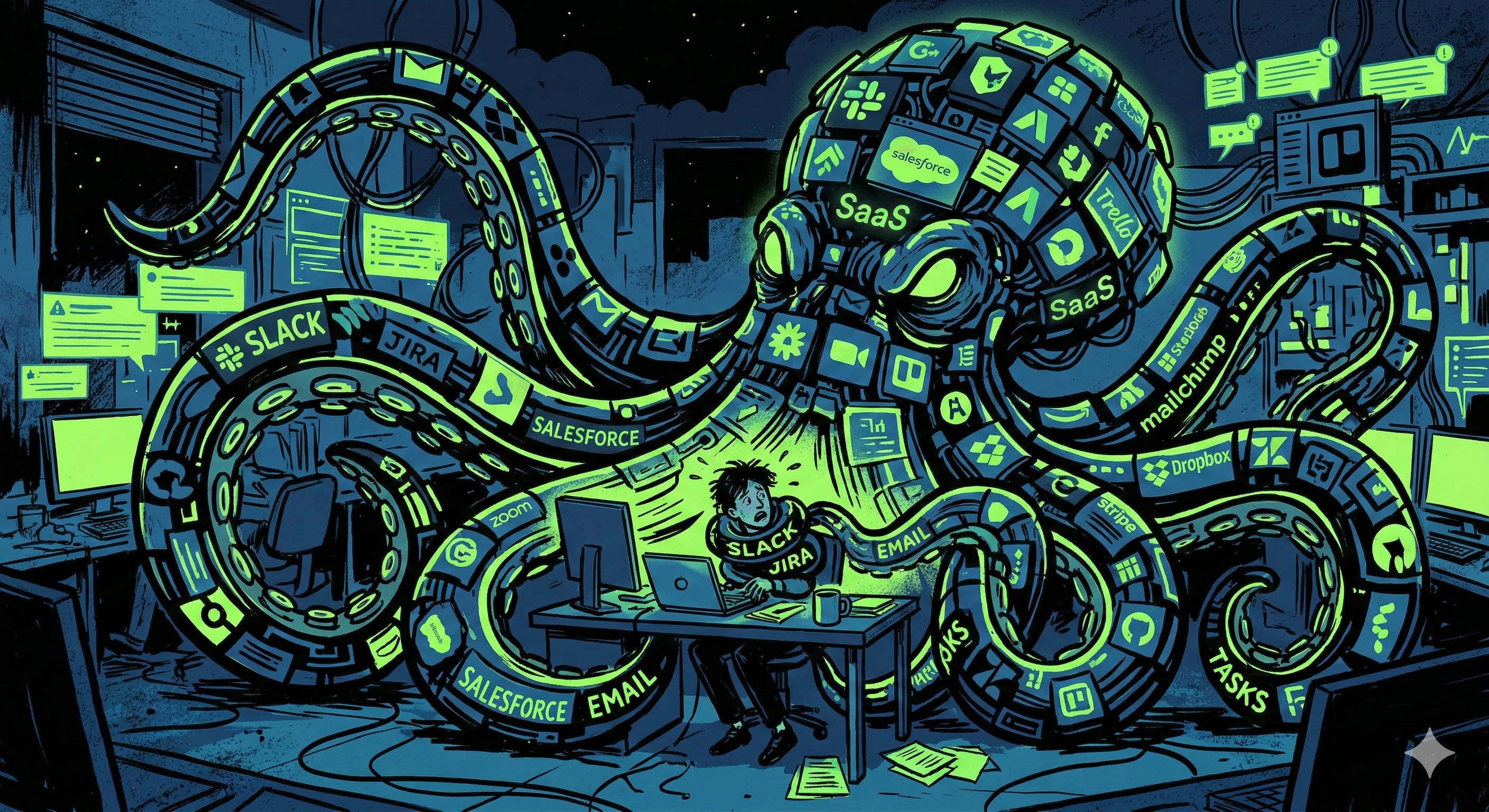
The most dangerous sentence in enterprise software right now: “We have AI built in.” That’s not innovation. That’s lock-in wearing a new label.
The Play
Salesforce launches Agentforce. HubSpot ships Breeze AI. Oracle embeds “Ask Oracle” into NetSuite. Every major SaaS vendor is racing to add AI to their platform.
The pitch sounds great: no extra tools, no integration headaches, everything works together. But every AI workflow you build inside their platform adds another strand to the web keeping you there. Not just data lock-in. Something worse: behavioral lock-in.
What “Built-In AI” Actually Costs
Each vendor wraps the same play in different packaging.
Salesforce Agentforce charges $2 per conversation. Sounds cheap until your support team handles 500 chats a day. The full AI suite starts at $550/user/month, and Salesforce has raised prices twice in two years.
HubSpot Breeze AI runs on credits that drain fast. A sales team of ten burns through the monthly allocation in their first week. Overages cost extra, and every agent action eats credits.
Oracle’s NetSuite Next bakes AI into everything: natural language queries, automated reconciliation, vendor selection. Every feature runs exclusively on NetSuite data. The deeper you go, the harder it is to imagine life without it. That’s the point.
| Agentforce | Breeze AI | NetSuite Next | OpenClaw | |
|---|---|---|---|---|
| Open source | — | — | — | |
| Own your data | Limited export | Limited export | Oracle-locked | Full control |
| Switch without rebuilding | — | — | — | |
| Choose your AI model | — | — | — | |
| Price increases | 6-9%/year | Tier-based | Oracle pricing | You control infra |
How Lock-In Actually Works
Vendor lock-in isn’t a single wall. It’s layers.
Traditional lock-in is about data: your contacts live in Salesforce, your deals live in HubSpot, your financials live in NetSuite. That’s painful enough.
AI lock-in adds two more layers:
Behavioral lock-in. Your AI has learned how your team categorizes leads, routes support tickets, and drafts follow-ups. That knowledge lives inside the vendor’s model. You can export your data. You cannot export your AI’s learned behavior.
Workflow lock-in. Every AI-powered automation you build uses proprietary connectors, proprietary prompt formats, and proprietary APIs. Agentforce workflows don’t run on HubSpot. Breeze agents don’t run on Salesforce. Rebuild from scratch every time you switch.
One analyst described Salesforce’s approach to CIO.com: “Not traditional technical lock-in where migration is impossible. It is behavioral lock-in created by layered dependency over time.”
The Veeva Warning
Veeva Systems built its entire CRM on the Salesforce platform. When they decided to leave, the migration required a 5-year wind-down (2025-2030). That was before AI workflows existed. Now imagine rebuilding not just data and integrations, but every AI-trained behavior from zero.
The Alternative: Build on Neutral Ground
The way out isn’t “no AI.” It’s AI on infrastructure you control.
OpenClaw is open-source. Your agent runs on your infrastructure. You choose the AI model. You own the data, the workflows, and the trained behaviors. Switch hosts, swap models, change channels — nothing breaks.
n8n does the same thing for workflow automation. Both are growing fast because the demand is real: companies want AI they control.
What Switching Actually Looks Like
With open-source, the math changes completely. A hosted OpenClaw agent costs under $100/month for work that runs thousands on Agentforce or Breeze. But the price difference isn’t even the real story.
The real story: when Salesforce raises prices next year (they will), you can’t move your Agentforce workflows anywhere else. With OpenClaw, you swap hosts the way you’d swap web servers. Your data, your workflows, your agent’s learned behaviors come with you.
How to Evaluate Any “AI Built-In” Pitch
Three questions to ask before you commit:
Can I take my AI’s knowledge with me? Not just data. The routing rules, the response patterns, the behaviors your team trained over six months. If you can’t export that, it’s a hostage.
What happens when I stop paying? Do your AI workflows disappear? Can you run them somewhere else? Or are you starting over?
Can I switch AI models? Foundation models improve every quarter. If your vendor locks you into one, you miss every improvement that comes next.
The Best AI Strategy Is One You Can Walk Away From
The fastest-changing technology in history demands the most flexible infrastructure. Locking your AI workflows into a platform that charges per conversation, restricts your LLM choices, and raises prices annually is the opposite of flexibility.
Open-source doesn’t mean unsupported. Managed OpenClaw hosting gives you the same reliability as Agentforce or Breeze, without the lock-in. Your data stays yours. Your workflows stay portable. Your AI learns on your terms.
Bottom line: Every AI workflow you build on a proprietary platform makes it harder to leave. OpenClaw is open-source, runs on any infrastructure, and works with any AI model. The best AI strategy isn’t the most advanced. It’s the one you can walk away from. Get started with hosted OpenClaw — three minutes, no lock-in.