
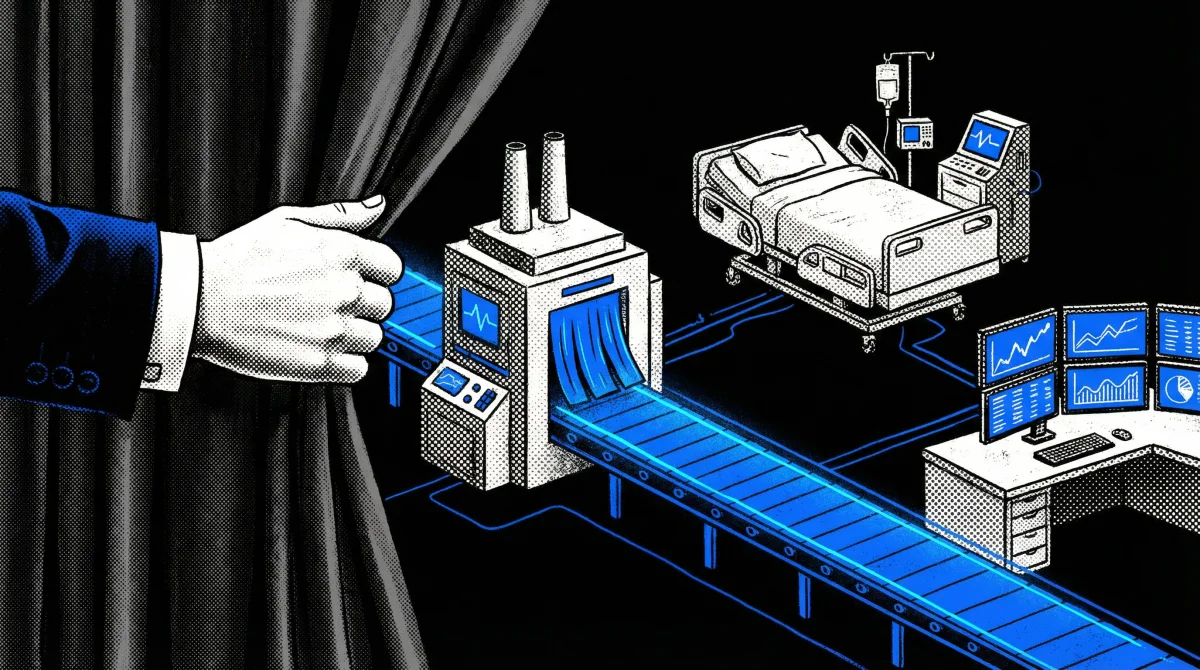
The AI agent market hit $7.6B. Most deployments fail. Here’s what separates the 5% that work from the 95% that become expensive PowerPoint slides.
The $7.6B Problem
We tested AI agents across healthcare, manufacturing, and financial services. One hospital cut patient check-in from four minutes to ten seconds. One manufacturer’s QC caught defects the human eye can’t see. But another agent sent follow-ups to closed-lost accounts at 3am. And another deleted a production database because nobody scoped its permissions.
The market crossed $7.6B last year. Analysts project $50B by 2030. Every vendor added “agentic” to their pitch deck.
The numbers they don’t show:
- 95% of enterprise AI pilots fail to deliver measurable ROI. MIT found this across 150 executive interviews and 300 deployments.
- 40% of agentic AI projects will die by 2027. Gartner’s prediction.
- Only ~130 vendors out of thousands build real AI agents. The rest slapped a new label on their chatbot. Gartner calls it “agent washing.”
The market is real. Most of its companies aren’t.
Three Mistakes That Kill AI Agent Projects
MIT’s research identifies the same three mistakes:
1. Wrong problem. Most AI budgets go to sales and marketing. Back-office automation — billing, data entry, internal routing — delivers the biggest ROI. Companies buy the flashy thing instead of fixing the expensive thing.
2. Building instead of buying. Vendor-built solutions succeed 67% of the time. Internal builds? 33%.
3. No data strategy. An AI agent processes patient records, manufacturing specs, or financial data — where does that go? Who else can see it? For regulated industries, a cloud-hosted agent isn’t a solution. It’s a liability.
Where It’s Actually Working
The industries with the most pain see the best results.
Healthcare: AI adoption jumped from 3% to 22% in two years. One hospital cut check-in from four minutes to ten seconds. Another cut coding denials by 59%. The catch: patient data can’t leave the building.
Manufacturing: Agents predict when machines break before they break. Amazon saved $4B a year. Maersk cut shipping delays by 67%. Drug manufacturers face FDA quality mandates and efficiency pressure simultaneously — one agent that solves both is worth the investment.
Financial services: Top performers earn $8 for every $1 they invest. Insurance adoption quadrupled in one year. High-volume processes with clear rules. Boring, profitable automation.
The common thread: Every winner picks one specific, measurable process. One workflow. One metric. One quarter to prove it.
The Risks
The slide that never reaches the board deck:
| What They Say | What’s Happening | |
|---|---|---|
| Security | “Enterprise-grade” | 88% of orgs reported AI agent security incidents last year. 1.5M agents run without oversight. |
| Cost | “Reduces headcount” | AI costs surge 36% YoY. A single workflow can hit $63K/month in API fees. |
| Data | “Your data is safe” | 97% of breached orgs lacked basic access controls. Your data sits on their server. |
| Compliance | “We’re compliant” | EU AI Act takes effect for high-risk systems in 2026. 250+ AI bills span 34 states. You hold the liability. |
Agents never say “I don’t know.” A CRM agent that hallucinates a contact’s job title won’t throw an error — it updates the field. You find out when your sales rep opens with “Congrats on the CFO role, Sarah” and Sarah is still in marketing.
They fail silently. An agent that processes 95% of tasks correctly and quietly mangles 5% causes more damage than one that breaks on day one.
You hold the liability. When the agent sends a bad email or updates pricing incorrectly — you own the consequences.
The Deployment Model That Fixes This
Every risk above has the same root cause: you don’t control the machine.
OpenClaw is an open-source AI agent that runs on hardware you control. It handles tasks, talks to your team through Slack or WhatsApp, and remembers everything between sessions.
Why this matters:
Your data stays yours. Patient records never reach OpenAI. Manufacturing data never leaves the plant. For healthcare, manufacturing, and finance — where regulators require you to control your data — this matters.
No vendor lock-in. It’s open source. Your workflows survive any vendor disappearing.
Predictable costs. No per-query fees. Clients running local models see the hardware pay for itself in five months.
Full auditability. Every action logged. Exact permissions. When compliance asks “what does this AI have access to?” — you answer with specifics.
Three Questions Before You Spend a Dime
1. “What’s our most expensive manual process?”
Not the most exciting. The most expensive. Medical coding. Invoice processing. Data reconciliation. Quality inspections. That’s your starting point.
2. “Where does the data go?”
If the answer is “their cloud,” ask what happens when there’s a breach. In healthcare, manufacturing, or finance — this question eliminates 80% of vendors.
3. “What happens if this vendor disappears?”
If your AI strategy depends on one vendor staying alive, you have a dependency, not a strategy.
Where to Start This Quarter
Month 1: Pick one process. The most repetitive, highest-cost workflow. Run the numbers: what does it cost you monthly in labor, errors, and delays?
Month 2: Pilot with guardrails. One process. Hybrid mode — the agent drafts, you approve. Four rules from day one:
- Dedicated machine, dedicated accounts. Contain the blast radius.
- Human-in-the-loop for anything external. Drafts, not sends.
- Audit logs. Log every action somewhere you’ll actually check.
- One job at a time. An agent that does one thing well beats one that does ten things unpredictably.
For regulated industries, run it on your hardware with OpenClaw’s local setup.
Month 3: Decide. If it saved money and didn’t break anything, expand. If not, you spent a month and got real data for the board instead of a vendor’s slide deck.
The 5% that succeed start with “this process costs too much” — not “AI strategy.” Then they pick the deployment that keeps them in control. The broader shift from workflow tools to agentic systems is already underway — here’s why.
Bottom line: The 5% of AI agent projects that succeed start with “this process costs too much,” not “AI strategy.” Pick your most expensive manual process. Pilot it for one month with guardrails. Measure. OpenClaw runs on hardware you control. Your data stays yours. Compare hosting options or join PageLines Community.