
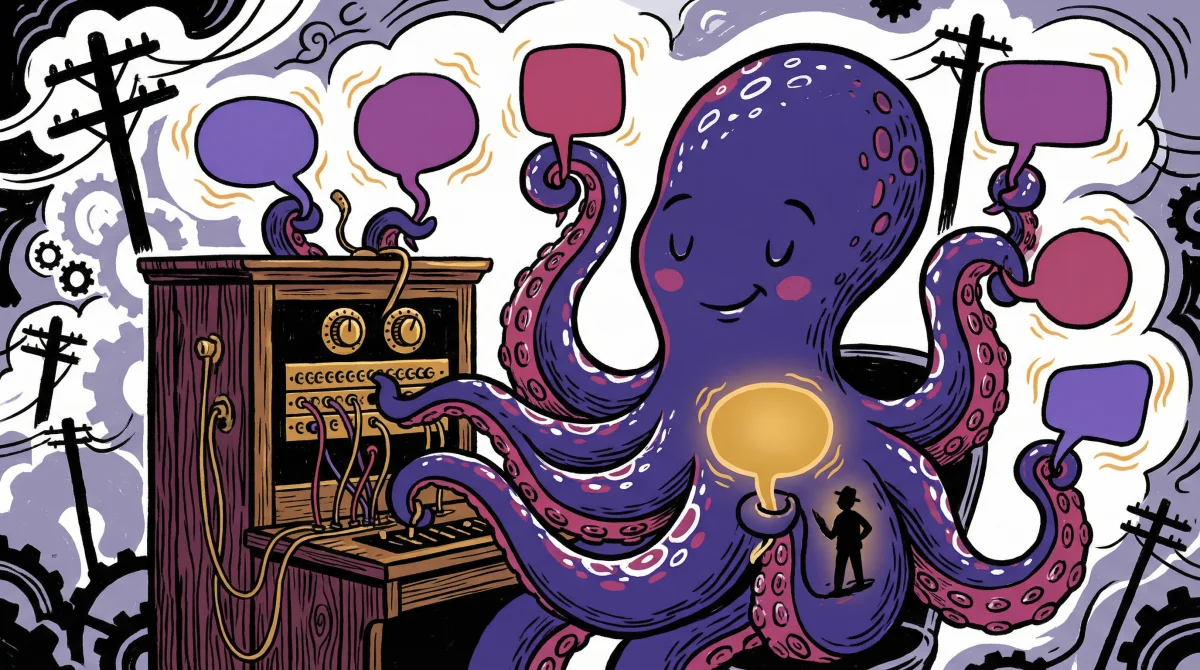
Klarna replaced 700 support agents with AI. Resolution time dropped from 11 minutes to two. Then satisfaction cratered, complaints surged, and they hired humans back. The tech worked. The strategy didn’t.
The Mistake Everyone’s Making
Klarna’s bot handled 2.3 million conversations in its first month. Two-thirds of all chats. Resolution dropped from 11 minutes to under two. Repeat questions fell 25%. They projected $40M in annual savings.
Then reality hit.
Customers got generic, repetitive answers. Billing disputes got the same tone as a password reset. Their CEO admitted publicly: “We focused too much on efficiency and cost. The result was lower quality.” By mid-2025, they reversed course and started rehiring.
The lesson: replacement doesn’t work. Augmentation does. The entire industry is shifting from rigid automation to adaptive agents.
Why Chatbots Keep Failing
68% of customers report bad chatbot experiences. The top complaint: the bot doesn’t understand the question.
Most “chatbots” follow scripts, not conversations. They’re decision trees — if/then logic wearing a chat interface. Customer says X, bot responds with Y. Anything off-script: “I’m sorry, I didn’t understand that.”
| Script Chatbots | AI-Only (Klarna) | OpenClaw Hybrid | |
|---|---|---|---|
| Understands natural language | — | ||
| Handles complex or emotional issues | — | Poorly | Routes to human |
| Learns from conversations | — | ||
| Always on, 35+ languages | Limited | ||
| Keeps satisfaction scores high | — | — | |
| Runs on your hardware | — | — | |
| Pick your own model | — | — | |
| Cost per conversation | $2-5 | $0.50 | $0.50 |
Only 29% of companies have moved past basic scripted chatbots.
How Your OpenClaw Bot Handles Support
Messages from any channel — WhatsApp, Telegram, email, Discord, web chat — flow through one brain. The bot reads and routes every incoming message in under two seconds.
Three paths:
Routine (80%). “Where’s my order?” “How do I reset my password?” “What’s your return policy?” Answered instantly. No queue. No hold music.
Complex (15%). Billing disputes, multi-step problems, things with moving parts. The bot knows it can’t solve this alone — routes to your team with the full conversation, account history, and a suggested fix. Your person opens a ticket that’s already half-solved.
Emotional (5%). Angry customer. Bad experience. Someone who needs to feel heard. The bot detects the tone, says “let me get someone who can help,” and hands off immediately. A real person, within seconds, with all context.
The Handoff Is Everything
Klarna’s mistake wasn’t using AI. It was removing the escape hatch.
When the bot treats every conversation the same — password resets and billing disputes, simple questions and emotional complaints — quality collapses. A bot that’s great at “where’s my package” is terrible at “you charged me three times and I’m canceling.”
Your OpenClaw bot knows the difference. When it hands off, the human doesn’t start from zero:
- Full conversation so far
- Customer’s account and history
- The bot’s read on the issue
- Suggested next steps
That context cuts handling time 40-50%. Vodafone proved it: their support bot handles a million conversations a month, resolves 70% on the spot. The 30% that escalate arrive with full context. Customer satisfaction jumped 14 points.
Your Bot, Your Hardware
OpenClaw takes the opposite approach.
Zendesk, Intercom, Salesforce — they all run on someone else’s servers. They store your customer conversations, billing details, and complaint history in their cloud. 88% of companies reported AI-related security problems last year.
OpenClaw runs on your machine. A Mac Mini in your office. A server in your building. A cloud instance on your own account. Customer data never leaves your environment.
If you’re in healthcare, finance, or anything regulated: this isn’t a nice-to-have. It’s the difference between passing your next audit and explaining a breach.
What you own:
- Every conversation log
- Your bot’s learned patterns and memory
- Customer data the bot accesses
- The model itself (if running locally)
What we host (if you choose PageLines Hosted):
- A dedicated server running your bot around the clock
- Syncs to your Google Drive — personality, memory, contacts, skills all live in files you control
- Switch providers anytime. Your bot’s brain comes with you.
Pick Your Own Model
Most support tools lock you into one model. Cloud models change without warning, and if quality drops, you have no alternative.
OpenClaw lets you choose.
Cloud models for the best conversations: Claude, GPT-4, Gemini. Great for nuanced questions, complex reasoning, multilingual support.
Local models for full control: Run open-source models on your own hardware through Ollama. Zero cost per conversation after the hardware investment. No rate limits. No surprise changes. No one else logging your customer conversations.
The sweet spot: Start with a cloud model — fastest to set up, highest accuracy. Once your bot learns your recurring patterns, train a local model on your actual support conversations. A model tuned to your products, your customers, your tone. Running on your hardware. Zero per-conversation cost.
A Mac Mini ($2,000 one-time) pays for itself in 3-4 months versus cloud usage.
5,700+ Skills
Your bot doesn’t just answer questions. It takes action.
Out of the box:
- Look up orders and give real-time status
- Process requests — address changes, subscription updates, refund starts
- Search your knowledge base and quote answers with sources
- Escalate with context — full transcript and suggested fix attached to every handoff
- Watch every channel — email, Discord, Telegram, web chat, all at once
Need more? The skills marketplace has 5,700+ community-built add-ons. Calendar scheduling for callbacks. Shipping integrations. Inventory checks. Browse, add, done. No code.
Custom workflow? Drop a script into your Google Drive folder. Your bot picks it up in seconds.
The Math
A support rep costs $60-80K/year fully loaded. They handle about 50 conversations a day. That’s roughly $5-6 per conversation.
Your OpenClaw bot handles unlimited conversations at once. About $0.50 each with cloud models. Near-zero with local. That’s a 10x reduction on the 80% it resolves automatically.
For 500 tickets a month:
- Human only: ~$2,750/month
- Script chatbot + humans: ~$1,800/month (chatbot deflects 35%, rest escalates)
- OpenClaw cloud: ~$750/month (80% auto-resolved, 20% human)
- OpenClaw local: ~$380/month (same resolution, near-zero bot cost)
$24-28K saved per year. The bot works nights, weekends, and holidays.
What This Looks Like
A customer messages on Telegram at 2am: “I ordered the blue version but my confirmation says red. Can you fix this before it ships?”
Script chatbot: “I can help with order inquiries! Please provide your order number.” (It was in the message. The bot didn’t read it.)
AI-only bot: “I’ve updated your order from red to blue.” (What if blue is out of stock? What if it already shipped? No judgment.)
Your OpenClaw bot: Checks the order. Blue is in stock. Hasn’t shipped. Updates the color, sends a confirmation email, replies: “Done — switched to blue. Ships tomorrow, tracking by noon. Anything else?” Four seconds.
If blue were out of stock? The bot says “let me get someone who can sort this out,” and routes to your team with everything attached. They pick it up in the morning already knowing the problem.
Getting Started
Sign in with Google. Connect your support channels. The bot starts learning.
Days 1-3: It reads your past conversations in Google Drive. Learns your products, common questions, your team’s typical answers. Low-confidence responses go to your team.
Week 1: The bot handles simple questions automatically. You correct it maybe 10-15 times a day — three seconds each. Every correction trains your model, not a shared one.
Weeks 2-4: Accuracy climbs. Auto-resolution hits 60%, then 70%, then 80%. Your team focuses on the cases that actually need a human.
Month 2: You stop thinking about routine support. The bot handles it. Your team handles the interesting stuff. Customers get instant answers at 2am and a real person when they need one.
Bottom line: Klarna proved AI can handle millions of support conversations. They also proved replacing humans entirely backfires. Your OpenClaw bot handles the routine 80% — instantly, in any language, around the clock — and routes the rest to your team with full context. Runs on your hardware. Your choice of model. Your data stays yours. Set up your bot — three minutes, $29/month, first month free. See how hosting providers compare.