
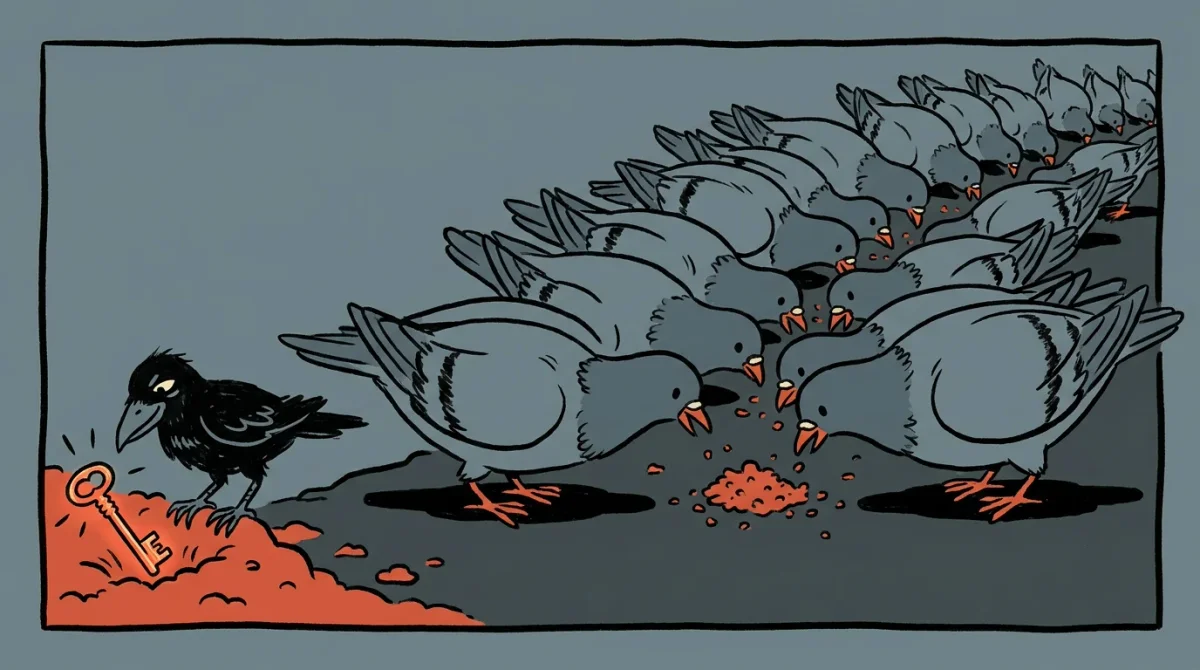
Asymmetric AI means using AI with what your competitors don’t have: what you know, who you know, and what you build. Everyone now uses the same AI, so everyone’s work looks the same.
AI makes everyone’s work look the same
People who use the same AI come up with the same ideas. A Wharton study asked people to invent a toy. People using ChatGPT came up with nearly identical toys, and nine gave theirs the same name. People without AI came up with different ideas.
Other studies found the same result. When consultants at BCG used AI, their work got better, but their ideas got more alike. Writers using AI wrote better stories, but their stories sounded more alike. AI lifts each person and pulls everyone to the same place.
Better work isn’t an advantage if everyone has it
When everyone improves the same way, nobody gets ahead. Michael Porter, the business strategist, warned that companies who copy the same best practices end up alike. Being alike is no advantage.
AI is now the best practice everyone copies. Your proposal and your competitor’s come from the same AI, so both improve and both look the same. Buyers notice, and most can now spot an email AI wrote.
The big AI companies do have an advantage
The companies that own the AI pull ahead. Amazon, Microsoft, Google, and Meta will spend more than $700 billion on AI this year. Everyone else rents the same AI from them for about $20 a month.
One side has something the other can’t match, and that gap is an asymmetric advantage. So how do the rest of us get one?
Your edge comes from what the AI can’t learn
The AI learns only what someone wrote down, and most of what makes you good at your work never was. Three things stay yours.
What you know. You know which pitch closed a deal last month and which email got replies. That never reached the internet, so the AI never saw it.
Who you know. People who trust you tell you the truth. AI can write an introduction, but it can’t make someone take your call.
What you build. You own and control your tools, so no company can raise the price or take them away. Open models make that possible.
Asymmetric AI joins the three: people you trust teach you something, and your own AI puts it to work.
Two sales managers with the same AI get different results
Two sales managers sell the same product with ChatGPT. The first asks it for follow-up emails and gets the emails everyone else gets.
A friend in her industry told the second which follow-up emails get replies. Her own AI rewrites her emails that way, using her customer list. They use the same AI, but she gets better results because she brought what he lacked.
AI alone vs. asymmetric AI
| AI alone | Asymmetric AI | |
|---|---|---|
| Same AI as your competitors | ||
| Lessons from people doing your job | — | |
| People who will take your call | — | |
| Tools you own | Rarely | |
| Works in your own email and customer list | Partly |
Start with your own ideas, then add AI
- Start with your own ideas. Then ask the AI. Starting with the AI puts you where everyone else starts.
- Write down what works. Note what you tried and what happened.
- Find people doing the same work. Trade results with people you trust.
- Give your AI what you learn. Have it apply what you know in your email, calendar, and customer list.
- Own your tools. Use tools you control, so no company can change the rules on you.
We learned this when WordPress copied us
PageLines made a popular website tool for WordPress with 67,000 customers. Then WordPress built the same thing into its own product. Whoever owns the platform can copy what you build on it.
AI companies now do that to everyone. They can’t copy what people know, who they trust, and what they build together. So PageLines starts with a community.
Bottom line: Everyone has the same AI, so AI alone won’t set you apart. Asymmetric AI adds what you know, who you know, and tools you own. PageLines is a community of AI leaders who share what works, and each member gets their own AI to put it to work. Membership is by invitation. See how it works.
Common questions
What is asymmetric AI?
Asymmetric AI means using AI with what your competitors don't have: what you know, who you know, and what you build. Everyone gets the same AI, so what you bring decides the result.
Why does AI make everyone's work look the same?
Everyone uses the same few models, and those models give similar answers. Studies of brainstorming, consulting, and writing found that AI made each person's work better and everyone's work more alike.
How do you get an advantage when everyone uses AI?
Start with your own ideas, keep track of what works, trade results with people doing the same work, and give that context to an AI that works only for you.